Showing posts with label Research. Show all posts

Friday, March 23, 2018

A Unique and Frugal Idea

I've made some dresses I really like. I've also made some dresses that I don't care for all that much. There have also been dresses that surprised me, like this dotted sheer. I was 100% AGAINST white when I decided to make a sheer dress, but being a cheapskate means beggars can't be choosers, so the dress material was bought for $5 a yard, somewhat grudgingly because...it was white.

It turned out to be extremely light and comfortable, and ultra-fashionable feeling! So cool in the dead heat of the summer too; I've worn it to a few events with 90 degrees +. The result was a nice surprise, but there were also a few drawbacks.

1. White in the sun makes you look like a blob. In pictures, and in real life. See below.
2. Apparently bugs are drawn to white. Not that that really bothers me, but people are always coming up and brushing the bugs off my dress.
3. A few people have said I look like Mary Poppins with my red waist. Now, I LIKE the red and white, but I hate associations. Not that I blame them, because it does.

And this wasn't even directly in the sun!

So my idea is to retire this dress, and make a new sheer/light cotton 1860's dress in a less bug-attracting color. Despite having owned this dress for maybe 3 or 4 years, it's in surprisingly good shape. Any stains have been successfully scrubbed out. Rather than keep this dress in my closet, I would love to pick it apart and remake it into something new entirely. The skirt is massive...at least 50% larger than the average 1860's dress. While that's not ideal, it does give me more cutting yardage for a new dress. I also have a yard or two up in my stash. I also made a dress for my sister in this same material, and if I give it a few years she'll outgrow it. Not that I want to wait a few years.....or that it won't be shredded by then.

Because I'm a fashion plate junky, I did some research of fashion plates that were sheer cotton, and with dots. Dots were typically flat-embroidered on in silk thread, rather than a little clipped tuft, so my material isn't perfectly accurate, but oh well. Here are some options in no particular order; keep in mind that each fashion plate has a different way of displaying the spots.

1. An 1880 house (or evening) dress, if of muslin made over a basic silk dress (the one on the right). I'm always a sucker for natural form, although I question whether I have enough fabric.
May 1880 Petersons Magazine

2. A 1799 Morning dress, with a little vest over the top. The length of the train might be limited to the length of the skirt, although by the time the tucks are let out it could be pretty long. I've already done a specifically 1799 dress, so this isn't my favorite option, but I'm leaving it on here because I really like the vest.
November 1799 Ladies Monthly Museum

3. An 1840 dinner or evening dress of white spotted gauze over white satin; the sleeves are black velvet (kind of a weird detail, right?). I feel like they might look like black holes on your arms in person. I could probably eek this out.
 March 1840 Le Follet

4. An 1841 evening dress, with an underskirt made in puffs. This one's a little frilly for me.

February 1841 Ladies Cabinet

5. An 1849 evening dress, with the underskirt of plain tarlatane. Love the basic-ness of it, and I definitely have enough yardage for this one.

February 1849 Godeys Magazine

6. An 1852 evening gown, trimmed with ribbon. I love almost everything about this design. I would probably need to wait, and use the skirt from my sister's dress for the upper layer.
March 1852 Le Moniteur de la Mode

7. An 1870 evening dress, with black bows down one side. I don't love bows, but I like black and white a lot, so there might be a way to come up with a different trim that suits my taste a little more. I would totally do black roses, if I thought they would be accurate. What I like about this one is I definitely have enough fabric, and it would feel a little like making an old dress over in a new style (rather than going back in time). Because of the square cut-bodice, I might not need to make a new bodice but just cut the current one down. Off-the-shoulder necklines typically need adjust and a basic cut-down from a high-necked dress usually doesn't work.
January 1870 Petersons Magazine.

8. An 1867 evening dress for the seaside; skirt and bodice of blue silk, with the overdress in dotted white. This might be a less frugal way of re-working this fabric, since it would only need a little bit, but there would definitely be enough; it's the figure on the right.
August 1867 Godeys Magazine

While I don't really need another evening dress, I wouldn't mind one. I like the variety of eras to choose from; while I've already done Natural form and Regency, I wouldn't mine doing them again, but I also wouldn't mind doing a new era. 

Which one is your favorite?

Friday, August 4, 2017

#3: Extant Garment: 1861-65 silk dress

The next dress was dated to just 1860's, but I'm guessing it was made between 1861-1865 (read to the end for dating). The textile director told me that she believes it was a mourning dress. It is made of a very thin black silk, sort of like a tissue weight taffeta.
Photo Credit: Idaho Historical Museum

Photo Credit: Idaho Historical Museum

Photo Credit: Idaho Historical Museum

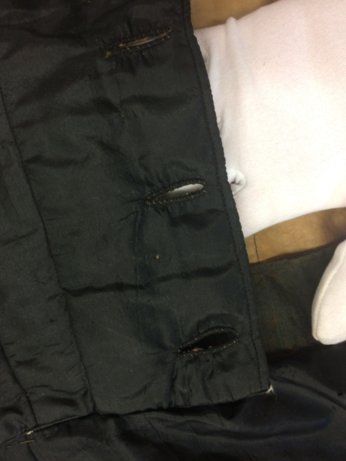
These were seriously super-strength buttonholes.
Photo Credit: Idaho Historical Museum
In the back, the pleats face towards the back; in the front, the pleats also face towards the back, which is a little less common than front-facing, but still relatively normal.  Photo Credit: Idaho Historical Museum

This dress was a little confusing, because of it's size. It was quite small, but it seems like a good guess that this dress was worn by a short lady. The total length was 38'' in the front, and the skirt circumference was only 115''. The modifications are very good and not theatrical. The skirt has a strip of about 2 1/2'' sewn onto the bottom that is discreet, but also wouldn't have been a part of the original design, and it also feels to be of a slightly different quality than the rest of the dress. The hem facing was only maybe 4'' high, and was of some sort of course brown stuff that almost felt like horsehair.
Photo Credit: Idaho Historical Museum


The inside lining also showed that the darts had originally been in a different location by the fading patterns, and then ripped out and moved over. Again, it was skillfully done, and despite the fading and stitch marks on the inside the outside showed no wear or stitch marks. I don't know how they managed that! How large the first darts were is difficult to discern. I did not get a very good picture of the fading, sorry!
You can also see the two different colors of lining.
Photo Credit: Idaho Historical Museum

The bodice closes up the front with functional buttons, but also has a row of hooks and eyes starting mid-bust going down to the waist to stabilize the whole thing. The shaped coat sleeves are unlined, and the only trim on the entire dress is a cuff-shaped piece sewn to just the outside portion of the dress with narrow braiding, also in black. The bodice was lined with two different shades of brown; the darker one in the front portion was twill, and the lighter color in the back was a plain weave that was either polished or plain, I can't remember.
Photo Credit: Idaho Historical Museum

A few construction peculiarities: the back curved detail seen on many dresses is actually a faux back; the entire back is cut as one piece, and then folded and top-stitched to appear to be three separate pieces. You can read more about how to do this in The Dressmaker's Guide. However, with this dress they didn't even bother to make a crease, there is simply a line of stitching! You can see in the large picture of the back how without the fold, it doesn't stand out quite so much; whether the maker was simply inexperienced, lazy, or pressed for time we will never know.
Photo Credit: Idaho Historical Musuem

The skirt has an excellent example of a dog-leg closure, and that striped fabric is a very short section of waistband that isn't visible from the outside. The skirt was attached straight to the bodice, except for a short portion that was attached to just the scrap band. The dress has piping on the neck edge, armscye, the bottom edge of the bodice and on the bottom edge of the sleeve.
Photo Credit: Idaho Historical Museum

The only thing we really have to work with is the sleeves, and the skirt. This style of sleeve is called a coat sleeve; a coat sleeve is characterized by being made of an outer piece and an inner piece sewn together in a curved shape. When the dress is hung up on a hanger, the sleeves will "shake hands". It's simple and tidy, and because it lays very flat it's a good base for a lot of fancy trim. Or, simply no trim. 
Mrs. James Guthrie, c. 1864-66, by Lord Frederick Leighton

The problem with coat sleeves, is that they are difficult to distinguish from a regular straight sleeve in a drawing; in photographs, it's pretty easy to see. The other problem with coat sleeves is that it seems as though fashion plates may have considered them "boring"; because of how many extant dresses have them, and how many women were photographed in them, we know they were very common. But based on a fashion plate.....you might not even know anyone wore them. Fashion plates still show them, but they generally are shown with undersleeves during the earlier 1860's. Like the previous pagoda sleeve fashion, except less droopy and still having a curved shape.

1861 Journal des Demoiselles; this particular example is an earlier style of coat sleeve that was only around for a few years, between 1860-1862. Sort of a cross between a coat sleeve, and a bishop sleeve. It has a lot of fullness at both the shoulder and the wrist, but unlike a plain bishop sleeve it has some shaping to make it curve inwards. 
1862 Petersons fashion plate; this is a good example of an open coat sleeve. It's very tailored, but still has a curved shape even though it's open. In 1862, we see examples like this, but also some that are larger and more open, but this was sort of the new sleek look. Some people still prefer to call all styles of open sleeve a pagoda sleeve. I prefer to think of a pagoda sleeve as having either no shaping on either seam, or some shaping on the front seam; open coat sleeves have shaping on the front and back seam, to keep it tailored and curved. To give it an exact title may be beside the point.
1863 Le Follet; this is the closest shape and size to the extant. It is a closed coat sleeve, meaning tapered to the wrist, and it's worn with cuffs instead of undersleeves. This is my no means cut and dry on the dating; there are dozens of examples from before and after this date that look just like this. It's a bit generic. Within the realm of photographs, we see a lot more variation on coat sleeve size, shape, and style than in fashion plate. Most photographs don't have a date, though.


1865 Les Modes Parisiennes; French fashion plates like this one were often recycled through American newspapers, but often 6 months to a year later! So this one may have not even made it to the states until 1866, if at all. The other fashion plates except for the Petersons follow this general rule as well. This style of coat sleeve is much more tailored, even from the extant dress, more common from 1864 all the way to 1870.

We see a few examples of coat sleeves in 1861, but they are increasingly more and more common each year, and are still fashionable even up until the early 1870's, although by then the shoulders were a bit less dropped.

The only other thing that we have to work with is the skirt. The skirt is constructed with plain rectangles, with the fullness about evenly distributed, with a little more towards the back. Right around 1864, most skirts are very commonly made with gores, although some women had been wearing gored skirts since 1861. The skirts are sewn with an angle so there is less fullness in the front at the very top. By 1865, they are gored enough so that there are almost no pleats in front. This skirt shape could have been worn as far as 1865, but even in that year it would have started looking a little outdated and would probably have been ripped apart to re-shape the skirt. 
1861 Journal des Demoiselles; this skirt shape is more generally round all the way around...
c. 1865, sold at auction.
While we don't know the exact date of this dress, the broad stripes show the gores I'm talking about. Goring the skirt takes out fulness at the top, which gives it a distinctly triangular shape at the top. The black extant dress uses straight rectangle panels, instead of triangle panels like this striped example. 

So between the sleeves and the skirt, it probably would have been constructed between 1861-1864, but could have been worn up until 1865-1866. It's also possible that it could have been made a year or two earlier, and then the sleeves redone in this year range. 

I also want to talk a little bit about who might have worn this dress before I go into mourning, because at a glance you might guess that it could have been worn by a child. The fullness is very narrow (115'' circumference), it's very short, etc. However (and this is a big however)....the difference between children's fashion and adult fashion is extreme. Children's dress, usually without exception during the 1860's, was not darted and boned. It also always closes up the back. The exception to this is sometimes you see pictures and fashion plates with buttons going down the front, but because there is no crease it is purely decorative, but even this is relatively uncommon. 


That being said - it could have been worn by a young woman who grew an inch or two in a couple places, but because most women stop growing between 15-17....it makes more sense that it was a hand-me-down. As a grown woman, you don't accidentally make it too short....you know exactly how long to make it. So this dress is most definitely a hand-me-down, or even possibly sold and bought second-hand. That also explains the dart placement; while I can't tell whether the old darts were larger or smaller, different body shapes need different placement, so I'm not even sure that matters.

Now, the final question: mourning or no?

While this dress is very plain, and possibly boring, this is a good example of what an average lady might have a best dress, or possibly just a conservative nicer dress. It fulfills what every magazine of the time describes as the dress for any occasion: black was considered to be in good taste, because it was never too flashy. And being over-dressed was, in several different magazine's opinions, vulgar and having good taste in dress often meant being cautious about sending the wrong message about your station through excessive dress.

An 1860's lady, in mourning

1860 Petersons:

"All the lighter kinds of mourning are a good deal affected by the changes in fashion; but the deepest style of black undergoes but little alteration, except in the shape of a bonnet, the cut of a sleeve, or the length of a sleeve. The material used is bombazine, and the trimming must consist only of folds of heavy English crepe. Broad folds of crepe may trim the skirt of the dress, but are not now considered as indespensible to deep mourning as formerly." 1.

Later in the same article -

"Where a less rigid kind of mourning is required, a fine black alpaca, or double width delaine, is worn.....with this dress, although black collar and sleeves are generally worn, still white crape, or tarleton collars, and sleeves are admissable. Black barege and grenadine are always used for summer wear in black, but the must be made very plainly and invariable worn over a black skirt and body lining".

"A still lighter kind of mourning is of black silk, trimmed with crape, or, if wished less deep, with black gauze ribbon, etc. The silk must be of a dead black and quite lustreless."

"After this stage of black, the style varies according to the fancy of the wearer. Small black and white plaids, purple and black, gray silks, lilac and white, are all worn for various depths of mourning.....in this stage of mourning, it is almost impossible to particularize the various combinations of colors, or the styles of dress. Much more trimming is allowable; lace or worked collars may be worn, gloves may be of lilac, gray or pearl...."
1860-65 dress that is a perfect example of half-mourning. From the Les Arts Decoratifs

So there is a common theme among the first few examples: BLACK. And not just any black, but things like dead black, or lustreless black. Crepe, bombazine, and barege in black colors actually absorb light; the reason being that they are made of wool or wool/silk mixture. A women in mourning is a bit like looking at a black hole. This dress is too shiny to be considered proper for full mourning; however, it is acceptable for half-mourning.
Two 1860's ladies, in deep mourning.


1861 Godeys "In first mourning, black crape collars and cuffs on grenadine or crepe sleeves will still continue to be worn. The English fashion of adding a gold thread to the applique pattern in crepe , may find favor in New York, and at the South, but scarcely in neat, plain Philadelphia, where mourning usually is mourning, and not a mass of crepe bows, bugles, and tinsel."

1862 Petersons; there was a pattern originally included, and while this wrapper isn't specifically for mourning, they give the suggestion that you make the dress in black delaine, with the front made in black silk quilted in white for mourning.

January 1862, from Englishwomen's Domestic Magazine; in the comments on these dresses, they give suggestions on how both can be adapted to mourning by making them in a combination of black, gray, purple and white. Because women in full mourning were not expected to attend social functions like balls or evening parties, we can assume they mean half mourning.

Even though we now have evidence that this dress is appropriate for half-mourning....did it have to be? The answer is no! Black was considered fashionable and appropriate for almost every occasion, and magazines often give many examples of fashionable black, gray, and purple clothing with no mention of mourning of any kind. 
1861 Portrait of a Lady, by Ferdinand Krumholz. 

How do we know the above lady isn't in half-mourning? She has a white collar, and if you look closely you will see that she has a green ribbon on her left side. Women in full or half mourning were expected to wear caps on their head that were usually white. On her right side, look even closer and you will see....flowers! This is simply a very conservative dress. 

BONUS: A recipe from Petersons for how to re-blacken faded mourning clothes. "Black reviver, for faded mourning dresses, black coats, etc. 1. Boil in two pints of water down to one, two oz. of Aleppo galls, in powder, two oz. of logwood, one oz. of gum arabic, then add one oz of sulphate of iron. This may be evaporated to a powder. 2. Galls, eight oz; logwood, green vitriol, iron fillings, sumach, of each one oz; vinegar, two pints. 2


1. 1860 Petersons, pg. 86

2 1860 Petersons, pg. 406
For further reading on mourning, here is a podcast with Samantha McCarty:
http://blog.americanduchess.com/2017/05/Podcast-Episode-2.html

Wednesday, April 19, 2017

Extant Garment: 1850's Dress

This is Part Two in the 4-part series about a trip to the Idaho Historical Museum, in which I saw several different extant garments. See Part 1 here.

This next dress was simply written down as just 1850's; read to the end of the post to hear my thoughts on the actual dating of the dress.

This dress was absolutely breathtaking, but was ripped apart to some degree for theater. I did a pretty good job of not even bothering to take pictures of the modifications. Some of those things are: ripping off whatever lovely gauging was originally there and putting in a drawstring waist, shortening the skirt between the two tiers (although this was actually pretty discreet and might have been original), and putting in a large 3'' panel between the two front edges of the bodice because whoever wore it wasn't even close to small enough. That panel though....ack! If the dress is too small, then why bother?
Photo Credit: Idaho Historical Museum

The skirt panels were maybe the most beautiful fabric I've ever seen. They did a good job of matching the pattern across each tier, so it was close to seamless. The bottom ruffle measured 20'' from hem until the bottom edge of the next tier, then the next tier measured 18.5''. There was a section above that that didn't get measured, but the overall length was a little more than both of these combined. There was no hem along the bottom, because the print runs along the selvage, which was very small and neat. The skirt was lined with brown glazed cotton that stopped where the bottom tier was mounted on. The bottom edge had a narrow tape wrapped around it.

(Yes, that is a seam line right there)
Photo Credit: Idaho Historical Museum

The bodice is a solid gold silk, lined with the same brown glazed cotton as the skirt. The sleeves were so beautiful! They were open pagoda sleeves, lined with white silk halfway up. The inside of the sleeve was trimmed with box pleated white ribbon. The outside portion of the sleeve was trimmed with a matching brocade ribbon, 1 1/4'' wide and pleated, with tassels hanging from the points on the sleeves.
Photo Credit: Idaho Historical Museum
The back pleats were positively divine and laid so well, and thankfully hadn't been messed with. The original stitching on these was a little sloppy, but I think this dress must have fit it's original owner very well. A 5'' bone was stitched inside a casing up the center back; the total length of the pleating out the back measured 16.5'' from the natural waist to it's longest point.
Photo Credit: Idaho Historical Museum

This picture is of the underside of the basque, showing the sloppy stitching used to sew on the lower portion of the basque to the main bodice. 

Photo Credit: Idaho Historical Museum

The darts are boned with whalebone, with the bone being encased in a dart. The dart take-up was left inside the dress, but clipped. The waist of the bodice was 26.5''. The neck edge, armscye and bottom edge were all piped.
Photo Credit: Idaho Historical Museum
This dress might have been worn over a hoop petticoat or crinoline, which were invented in 1856. However, the 1858 Ladies Home Magazine advises that ladies choose the older style of horsehair or corded petticoat over the hoop skirt. Listen to this:

"....but, of course, a horse-hair skirt of modest dimensions, or a corded one is indispensable, unless a resort is had to hoops, and they take all the life, grace, and taste out of a skirt, by inflating it equally all round, instead of gracefully casting off the skirt more fully behind, and thus giving it an oval shape instead of a round hooped one." 1

A few key things I'm looking for to date this dress:

- A double-basque in the back, but doesn't extend around to the front
-Double tier skirt
-The pagoda sleeves (really large, open sleeves to be worn over puffy under sleeves)
-While I did use the color of the last gown, a semi-neutral color isn't helpful. But...I will look for - TASSELS!!

When looking at different 1850's fashion plates, a lot of skirts that look like a triple tier are actually a double skirt, with a basque that acts like a a third tier. Like this:
1858 Ladies' Home Magazine

The above plate is actually almost exactly what I'm looking for. The overall design is exactly the same, and hits 3/4 of the things I'm looking for. The only difference is that the basque extends all the way around, while the original golden dress is only in the back.

Basques:

1855 Peterson's

Basques are generally seen starting in 1855, but the overall dress design and silhouette is a little different than what I'm looking for. 

1855 Peterson's

In the 1858 Ladies Home Magazine, they state:

"As to basques, being confined to walking and home dresses, and not allowable for full dress, they are rather tolerated than commended and will last only another season. This affords a good opportunity for those ladies to whom they are unbecoming, and this includes all but the very tall, to discontinue them." 2

Towards the end of the same year, same magazine, they describe almost the exact same dress, but say that the ladies in Paris and New York think that the basque part of the dress is rather old-fashioned, having been in for 5 or 6 years. 
1857

In 1859, they are still used but are not so common.
In 1860, the references to basques are found mainly to describe coats, and counting the skirt part of the coat as a basque, but generally basques are completely disappeared.

After searching through literally 100 plates....I did not see a single dress with a basque only being attached in the back. I have a theory, but no way to prove it, so take it with a grain of salt.

When something new comes into fashion, it makes sense that, because it is new, you go ahead and make one in the most current style. But after something has been in style for, say, a year or two, and the overall style hasn't changed...you might branch out, and make one in a more unique and creative style. It doesn't make any sense that you would make a unique basque the exact year they have come into fashion, but it does make sense if you are looking to change it up a bit because you've seen the same thing for a year or two. So if we put basques between the years 1855-59...it makes sense that we might be seeing more creativity between 1857-59. I won't use this in the final decision on the dating of this garment, but it is food for thought.

Double skirt:

In 1855, skirts are usually either plain or many flounces. I saw one French plate with a double skirt, on a ball dress.

In 1856, about half and half between double skirts, and more tiers than that.
1856 Peterson's

In 1857, quite a few different number of tiers are being used, but they recommend a double skirt. "....for the plain skirt over a crinoline or hooped petticoat, is rather too balloony in appearance; and numerous flounces do not enliven a skirt which is so distended as to deprive it of drapery; thus the double skirt, here presented, is the accommodation entered into by and between hoops and petticoats." 3
1857 Ladies Home Magazine

In 1858, the Ladies Home Magazine says, 

"The skirt question is the most important one just now, and it seems to be regarded as of too great consequence to render a full decision upon yet, for flounces, double skirts, and quilles (lais de cotes) are equally fashionable."4

1858 Godey's Magazine

In December of 1858 in Godeys magazine, it says, 

"Double skirts are more worn than ever before; nearly all the imported robes, even in the richest cashmeres, mousselines, and all the silk and wool fabrics have them. Where the stripe or ornament occurs alternately, at the distance of a breadth apart, they are called robes a lez." 5

1859 Walking Dress, from Godeys Magazine. 


1859 Godeys Magazine

Tassels:

Interestingly enough, I could not find very many, if any, fashion plates with tassels. Fringe galore, but tassels are only in reference to coats and the like. But after flipping through other extants, there are plenty of examples, they just won't help prove a point.
c. 1858-60 Day dress, via the MET


ca. 1858 Day dress, via the V and A

 And then we have ALL THE FRINGE AND TASSELS....AT THE SAME TIME!!!
c. 1858 Day dress, via the Philadelphia Museum of Art. 

I don't use extants to date other extants, however looking through a list of originals is surprising. Browns, golds, and tans were very popular. If you just scroll through my 1850's Pinterest board, that color scheme is very common. Border prints (meaning large motifs worked across one edge of the fabric, instead of all over) were very popular, because of how well they could be shown off in a tier. Just for fun: the original dresses' twin!
c. 1859 American dress, from the MET

Now, in regards to the sleeves, it's a bit trickier because open sleeves worn with under sleeves was a popular style for a really long time. Take a look at my last research project, where I studied in-depth when that style first came into fashion, which was around 1848. For this particular dress, looking at the exact context and shape is important, because not all open sleeves look alike. 

First, you have sort of a tiny, funnel-shaped sleeve which is very long, coming at least to mid-forearm, but often longer than that:

1849 Godey's Fashion Plate

Then the sleeves graduate to a very long open sleeve, which is often slashed up very high in front. The actual shape of the sleeve is very triangular, and because of the slashing it tends to be very droopy. When I describe triangular, I'm not talking about the points on the sleeve, like this dress has; I'm referring to the way the top of the sleeve comes down from the armhole, with very straight seams. Some curve, especially on the inside of the arm, may be necessary, but especially the back of the arm will be very straight. The under sleeves that are worn with this particular style have to be longer than earlier and later styles, because of how much arm is exposed without them. This style is considered a pagoda sleeve.

1858 Ladies Home Magazine

And then later in the 1860's, the coat sleeve (a shaped, curved style that is fitted to the wrist without any gathers) is meshed with the pagoda to create what is considered an open coat sleeve. It's a little more tailored in appearance, without any droop, but can be anywhere from a modest-sized opening, to gigantic. There is a decided curve in the arm part without any major slashing, coming down to about mid-forearm, or slit a little up to the elbow, but not above. One key fact with open coat sleeves, is that it is generally curved enough to fit around the under sleeve that the inside part of the open sleeve doesn't show. With this golden dress, they took the time to trim the inside of the sleeve...because it was meant to be shown. The fancy lining and box-pleated trim would have looked amazing, drooping down over an under sleeve. So this dress has pagoda sleeves. Both the pagoda and open coat were worn up until 1862, but generally the droopy triangle shape is not so much worn. 
1862 Petersons' Magazine

This particular dress has pagoda sleeves, based on the fact that there isn't any crazy shaping. There is a small slash, but it doesn't come up very far. It's a bit generic, and style could have been worn anywhere between 1855-1860.

Overall conclusion: 1856-59, but really leaning more towards 1857-58.

I can't attach every single 1850's gown from my research board, but if you feel like looking through it, it's really easy to see a lot of similarities. Double tier, basque, open sleeves.....tell me if you find any with tassels used in this way!


5 Godey's Magazine, Volume 57, Page 570

Link to a Pinterest board with original 1850's dresses:
https://www.pinterest.com/michaelacoy9/1850-1859-day-dress/
Link to Pinterest board with 1850's fashion plates:
https://www.pinterest.com/michaelacoy9/1850-1859-fashion-plates/