Showing posts with label 1860's. Show all posts

Monday, August 7, 2017

#7: Made for Someone Else

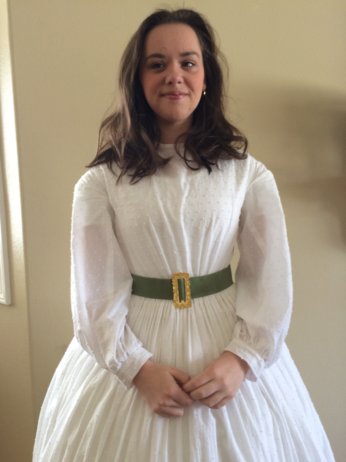
This dress was made just for fun. Camille was wanting a nice dress that could be worn with a hoop, so the hoop is new as well. This dress was made around a year ago, and has been worn maybe 3 times since then. We don't get out much.

The half-high lining that shadows through you can kind of see in the upper sleeve. The lining is boned, and buttons up the back. It's a seperate garment, so it can be washed without the dress.


I really wanted to recreate this particular fashion plate from 1862, but Camille wanted a high-necked, long-sleeved dress with a half-high lining. She once wore a low-necked, short sleeved dress to an event, and she burned her upper shoulder and neck area really badly. So I think she sees the practicality of covering more skin, so it is practical for outdoor wear, despite being white. This fabric is relatively easy to spot treat/scrub.
1862 Magasin des Demoiselles fashion plate

At some point I would really like to make this fancy belt with a sash; I think it's awesome, but she doesn't care for it.

This was the first dress were I allowed a significant drop in overall length; it feels much longer than her previous dresses. Almost full length, but in reality is still 8'' off the ground.

The bound ruffles are what inspired the trimmed tucks; I don't have documentation for silk-trimmed tucks, but the overall effect is plausible. We have plans to sew on covered buttons down the back.

This belt buckle is from Ensembles of the Past. It is absolutely beautiful, and I really want one in every color!

The bonnet was made in winter of 2015. It looks very well with the entire dress.

The hoop was made using The Laced Angel's instructions. Most of the hoop measurements were used, with slight modifications. This is the first day dress she's worn with a hoop.

Friday, August 4, 2017

#3: Extant Garment: 1861-65 silk dress

The next dress was dated to just 1860's, but I'm guessing it was made between 1861-1865 (read to the end for dating). The textile director told me that she believes it was a mourning dress. It is made of a very thin black silk, sort of like a tissue weight taffeta.
Photo Credit: Idaho Historical Museum

Photo Credit: Idaho Historical Museum

Photo Credit: Idaho Historical Museum

These were seriously super-strength buttonholes.
Photo Credit: Idaho Historical Museum
In the back, the pleats face towards the back; in the front, the pleats also face towards the back, which is a little less common than front-facing, but still relatively normal.  Photo Credit: Idaho Historical Museum

This dress was a little confusing, because of it's size. It was quite small, but it seems like a good guess that this dress was worn by a short lady. The total length was 38'' in the front, and the skirt circumference was only 115''. The modifications are very good and not theatrical. The skirt has a strip of about 2 1/2'' sewn onto the bottom that is discreet, but also wouldn't have been a part of the original design, and it also feels to be of a slightly different quality than the rest of the dress. The hem facing was only maybe 4'' high, and was of some sort of course brown stuff that almost felt like horsehair.
Photo Credit: Idaho Historical Museum


The inside lining also showed that the darts had originally been in a different location by the fading patterns, and then ripped out and moved over. Again, it was skillfully done, and despite the fading and stitch marks on the inside the outside showed no wear or stitch marks. I don't know how they managed that! How large the first darts were is difficult to discern. I did not get a very good picture of the fading, sorry!
You can also see the two different colors of lining.
Photo Credit: Idaho Historical Museum

The bodice closes up the front with functional buttons, but also has a row of hooks and eyes starting mid-bust going down to the waist to stabilize the whole thing. The shaped coat sleeves are unlined, and the only trim on the entire dress is a cuff-shaped piece sewn to just the outside portion of the dress with narrow braiding, also in black. The bodice was lined with two different shades of brown; the darker one in the front portion was twill, and the lighter color in the back was a plain weave that was either polished or plain, I can't remember.
Photo Credit: Idaho Historical Museum

A few construction peculiarities: the back curved detail seen on many dresses is actually a faux back; the entire back is cut as one piece, and then folded and top-stitched to appear to be three separate pieces. You can read more about how to do this in The Dressmaker's Guide. However, with this dress they didn't even bother to make a crease, there is simply a line of stitching! You can see in the large picture of the back how without the fold, it doesn't stand out quite so much; whether the maker was simply inexperienced, lazy, or pressed for time we will never know.
Photo Credit: Idaho Historical Musuem

The skirt has an excellent example of a dog-leg closure, and that striped fabric is a very short section of waistband that isn't visible from the outside. The skirt was attached straight to the bodice, except for a short portion that was attached to just the scrap band. The dress has piping on the neck edge, armscye, the bottom edge of the bodice and on the bottom edge of the sleeve.
Photo Credit: Idaho Historical Museum

The only thing we really have to work with is the sleeves, and the skirt. This style of sleeve is called a coat sleeve; a coat sleeve is characterized by being made of an outer piece and an inner piece sewn together in a curved shape. When the dress is hung up on a hanger, the sleeves will "shake hands". It's simple and tidy, and because it lays very flat it's a good base for a lot of fancy trim. Or, simply no trim. 
Mrs. James Guthrie, c. 1864-66, by Lord Frederick Leighton

The problem with coat sleeves, is that they are difficult to distinguish from a regular straight sleeve in a drawing; in photographs, it's pretty easy to see. The other problem with coat sleeves is that it seems as though fashion plates may have considered them "boring"; because of how many extant dresses have them, and how many women were photographed in them, we know they were very common. But based on a fashion plate.....you might not even know anyone wore them. Fashion plates still show them, but they generally are shown with undersleeves during the earlier 1860's. Like the previous pagoda sleeve fashion, except less droopy and still having a curved shape.

1861 Journal des Demoiselles; this particular example is an earlier style of coat sleeve that was only around for a few years, between 1860-1862. Sort of a cross between a coat sleeve, and a bishop sleeve. It has a lot of fullness at both the shoulder and the wrist, but unlike a plain bishop sleeve it has some shaping to make it curve inwards. 
1862 Petersons fashion plate; this is a good example of an open coat sleeve. It's very tailored, but still has a curved shape even though it's open. In 1862, we see examples like this, but also some that are larger and more open, but this was sort of the new sleek look. Some people still prefer to call all styles of open sleeve a pagoda sleeve. I prefer to think of a pagoda sleeve as having either no shaping on either seam, or some shaping on the front seam; open coat sleeves have shaping on the front and back seam, to keep it tailored and curved. To give it an exact title may be beside the point.
1863 Le Follet; this is the closest shape and size to the extant. It is a closed coat sleeve, meaning tapered to the wrist, and it's worn with cuffs instead of undersleeves. This is my no means cut and dry on the dating; there are dozens of examples from before and after this date that look just like this. It's a bit generic. Within the realm of photographs, we see a lot more variation on coat sleeve size, shape, and style than in fashion plate. Most photographs don't have a date, though.


1865 Les Modes Parisiennes; French fashion plates like this one were often recycled through American newspapers, but often 6 months to a year later! So this one may have not even made it to the states until 1866, if at all. The other fashion plates except for the Petersons follow this general rule as well. This style of coat sleeve is much more tailored, even from the extant dress, more common from 1864 all the way to 1870.

We see a few examples of coat sleeves in 1861, but they are increasingly more and more common each year, and are still fashionable even up until the early 1870's, although by then the shoulders were a bit less dropped.

The only other thing that we have to work with is the skirt. The skirt is constructed with plain rectangles, with the fullness about evenly distributed, with a little more towards the back. Right around 1864, most skirts are very commonly made with gores, although some women had been wearing gored skirts since 1861. The skirts are sewn with an angle so there is less fullness in the front at the very top. By 1865, they are gored enough so that there are almost no pleats in front. This skirt shape could have been worn as far as 1865, but even in that year it would have started looking a little outdated and would probably have been ripped apart to re-shape the skirt. 
1861 Journal des Demoiselles; this skirt shape is more generally round all the way around...
c. 1865, sold at auction.
While we don't know the exact date of this dress, the broad stripes show the gores I'm talking about. Goring the skirt takes out fulness at the top, which gives it a distinctly triangular shape at the top. The black extant dress uses straight rectangle panels, instead of triangle panels like this striped example. 

So between the sleeves and the skirt, it probably would have been constructed between 1861-1864, but could have been worn up until 1865-1866. It's also possible that it could have been made a year or two earlier, and then the sleeves redone in this year range. 

I also want to talk a little bit about who might have worn this dress before I go into mourning, because at a glance you might guess that it could have been worn by a child. The fullness is very narrow (115'' circumference), it's very short, etc. However (and this is a big however)....the difference between children's fashion and adult fashion is extreme. Children's dress, usually without exception during the 1860's, was not darted and boned. It also always closes up the back. The exception to this is sometimes you see pictures and fashion plates with buttons going down the front, but because there is no crease it is purely decorative, but even this is relatively uncommon. 


That being said - it could have been worn by a young woman who grew an inch or two in a couple places, but because most women stop growing between 15-17....it makes more sense that it was a hand-me-down. As a grown woman, you don't accidentally make it too short....you know exactly how long to make it. So this dress is most definitely a hand-me-down, or even possibly sold and bought second-hand. That also explains the dart placement; while I can't tell whether the old darts were larger or smaller, different body shapes need different placement, so I'm not even sure that matters.

Now, the final question: mourning or no?

While this dress is very plain, and possibly boring, this is a good example of what an average lady might have a best dress, or possibly just a conservative nicer dress. It fulfills what every magazine of the time describes as the dress for any occasion: black was considered to be in good taste, because it was never too flashy. And being over-dressed was, in several different magazine's opinions, vulgar and having good taste in dress often meant being cautious about sending the wrong message about your station through excessive dress.

An 1860's lady, in mourning

1860 Petersons:

"All the lighter kinds of mourning are a good deal affected by the changes in fashion; but the deepest style of black undergoes but little alteration, except in the shape of a bonnet, the cut of a sleeve, or the length of a sleeve. The material used is bombazine, and the trimming must consist only of folds of heavy English crepe. Broad folds of crepe may trim the skirt of the dress, but are not now considered as indespensible to deep mourning as formerly." 1.

Later in the same article -

"Where a less rigid kind of mourning is required, a fine black alpaca, or double width delaine, is worn.....with this dress, although black collar and sleeves are generally worn, still white crape, or tarleton collars, and sleeves are admissable. Black barege and grenadine are always used for summer wear in black, but the must be made very plainly and invariable worn over a black skirt and body lining".

"A still lighter kind of mourning is of black silk, trimmed with crape, or, if wished less deep, with black gauze ribbon, etc. The silk must be of a dead black and quite lustreless."

"After this stage of black, the style varies according to the fancy of the wearer. Small black and white plaids, purple and black, gray silks, lilac and white, are all worn for various depths of mourning.....in this stage of mourning, it is almost impossible to particularize the various combinations of colors, or the styles of dress. Much more trimming is allowable; lace or worked collars may be worn, gloves may be of lilac, gray or pearl...."
1860-65 dress that is a perfect example of half-mourning. From the Les Arts Decoratifs

So there is a common theme among the first few examples: BLACK. And not just any black, but things like dead black, or lustreless black. Crepe, bombazine, and barege in black colors actually absorb light; the reason being that they are made of wool or wool/silk mixture. A women in mourning is a bit like looking at a black hole. This dress is too shiny to be considered proper for full mourning; however, it is acceptable for half-mourning.
Two 1860's ladies, in deep mourning.


1861 Godeys "In first mourning, black crape collars and cuffs on grenadine or crepe sleeves will still continue to be worn. The English fashion of adding a gold thread to the applique pattern in crepe , may find favor in New York, and at the South, but scarcely in neat, plain Philadelphia, where mourning usually is mourning, and not a mass of crepe bows, bugles, and tinsel."

1862 Petersons; there was a pattern originally included, and while this wrapper isn't specifically for mourning, they give the suggestion that you make the dress in black delaine, with the front made in black silk quilted in white for mourning.

January 1862, from Englishwomen's Domestic Magazine; in the comments on these dresses, they give suggestions on how both can be adapted to mourning by making them in a combination of black, gray, purple and white. Because women in full mourning were not expected to attend social functions like balls or evening parties, we can assume they mean half mourning.

Even though we now have evidence that this dress is appropriate for half-mourning....did it have to be? The answer is no! Black was considered fashionable and appropriate for almost every occasion, and magazines often give many examples of fashionable black, gray, and purple clothing with no mention of mourning of any kind. 
1861 Portrait of a Lady, by Ferdinand Krumholz. 

How do we know the above lady isn't in half-mourning? She has a white collar, and if you look closely you will see that she has a green ribbon on her left side. Women in full or half mourning were expected to wear caps on their head that were usually white. On her right side, look even closer and you will see....flowers! This is simply a very conservative dress. 

BONUS: A recipe from Petersons for how to re-blacken faded mourning clothes. "Black reviver, for faded mourning dresses, black coats, etc. 1. Boil in two pints of water down to one, two oz. of Aleppo galls, in powder, two oz. of logwood, one oz. of gum arabic, then add one oz of sulphate of iron. This may be evaporated to a powder. 2. Galls, eight oz; logwood, green vitriol, iron fillings, sumach, of each one oz; vinegar, two pints. 2


1. 1860 Petersons, pg. 86

2 1860 Petersons, pg. 406
For further reading on mourning, here is a podcast with Samantha McCarty:
http://blog.americanduchess.com/2017/05/Podcast-Episode-2.html

Wednesday, March 29, 2017

HSM #2: 1863 Ballgown Reproduction

Photo credit: My sister Camille! We're just discovering that she has an incredible eye for creative shots.

Whew, this project was supposed to be a quick bodice, and it turned into a 30-hour ordeal, complete with handsewn eyelets and a total of 4 different tries of the pleating down the front.

Short backstory: I bought this green plaid silk at a screaming deal in the fall of 2015. I only bought 6 yards (54'' wide) because I was short on money, but I really wanted the fabric. Fast forward to summer of 2016; I couldn't believe that I had managed to get an entire dress from 6 yards, with some leftover! Everyone who makes 1860's dresses recommends purchasing 7-8 yards. I was even able to match the plaid.

Fast forward again: It's 2017, and I want a new ballgown. As much as I love the red one, it's soooo heavy, and it was never fit me very well (my absolute first try at darts). I've lost 20 pounds accidentally in the last year, and I knew that I just didn't want to wear it again. So I pulled out the leftover fabric and checked to see if the pattern pieces would fit. Just barely...

I managed to cut out all the pieces exactly the way I wanted them....except the sleeves. There was no portion on my fabric that was big enough even to fit the sleeves on, much less to make sure they matched! So the sleeves are pieced, but I positioned each pieced part to fit about where my true armpit is (as opposed to the rotated underarm seam). 

On my last darted bodice dress (the day bodice to this ensemble), I fitted the darts with the bodice inside out. Now, it's come to my attention that I am a little lopsided (just a smidge). Can you see how this doesn't work out? 1/2'' smaller on one side, and with the dart pinned correctly on that side and then flip it right-side out, that smaller darts are now on the larger side. Duh. No wonder I've always been so confused as to why the center front isn't exactly in the front! These darts turned out so well, thanks Mrs. Clark!
Camille: "These lines right here are cool!"
Me: "What lines?"
"I mean seams."
"You mean the darts?"
"Yeah, those things!"

So this dress I tried pinning it with the right side out, then marking the seamline on the inside and flipping it around. With this technique, I also discovered that I always thought the seam of the dart had to be straight. But when you stop and think about it, it makes no sense to always make the darts straight. 

My normal way of boning is to just turn the dart into a casing and shoving the bone up the darts, but with a dart that curves at the top, the entire excess wasn't laying flat at all. After poking around, I found Jennifer Rosbrugh's article on historical boning, using 1860's original ball bodice's as examples. Bingo! So I sliced up the center of the dart, cut all the dart excess off (gulp!) and pressed them open. Then I whipped casings on by hand, centering them over the seam instead of off to one side.

Confession time: I have always had this mindset that I should make each and every seam as available as possible for future modifications, including darts. So up until now, I've always left the dart excess alone, even though it's a pain because all of my darts are HUGE. When I was at Costume College, I attended a class on 19th century bodice construction, and in the class the teacher taught that they never ever pushed boning into the dart. Well, I raised my hand and, a little bit timidly asked, "What if I want to keep the dart excess, instead of cutting it off?"

"Huh?" The teacher wasn't following me.

"You know, in case I want to adjust it in the future?"

"WELL WHY WOULD YOU WANT TO DO THAT???" She was looking at me like I had just sprouted cabbages from my ears. I kind of wanted to curl up and die. I don't know why the question was so preposterous to her, it was perfectly valid, but I was embarrassed enough that I didn't explain my reasoning. Reading between the lines: the real reason I have never cut off the darts is because I know I can't possibly have a 23'' waist forever, and it seemed reasonable to me that anyone who lived in the 1860's might have had the same concern.

I've since learned that certain fabrics like silk don't easily forget thread holes that have stress, so moving a dart may not work because the lines from the old darts will still probably show. That being said, it is still  possible; I went to my local museum to look at a few original 1860's dresses, and one of them you could clearly see the old dart line, and they had moved it over about two inches to the front. You couldn't even tell from the outside! But if your darts aren't perfectly straight, they may not lay well if you don't at least clip into them. Either way...you most likely will be making the excess unusable.

I wasn't originally intending to do a reproduction, but it felt like a waste to not do something that is at least similar to this dress that is in the Museum of Fine Arts in Boston. As much as I like this dress....I don't like bows. Not even a little bit. So I dropped the idea of a reproduction, and posted a picture of the blank dress on a Facebook page I'm a part of, the Civilian Civil War Closet, for ideas. It was a little overwhelming, but I also got some good ideas. But 99% of the suggestions were....bows. "Bows on the shoulders!" "Put a bow on the rump!" "Don't skimp - use ALL the bows!" Other suggestions included fringe, beading, contrasting flowers, lace, a bertha and ruching/pleating. So basically any type of bodice decoration ever seen, ever. But I was surprised that so many people encouraged the bows. So whether this counts as a reproduction I'm not sure.

The trim fabric is a matte polyester satin; I was planning on using cream-colored dupioni from Joanns, but they don't sell it anymore! This makes me mad; dupioni is always a nice backup for things like nicer linings and trim. The matte polyester is actually pretty nice, it doesn't have a crazy poly-sheen. It does add a surprising amount of weight to the dress, though. Originally I had a 4th bow sewn right onto this connecting tab in the back, but it was so heavy it drooped, so I ripped it off.

I used the Truly Victorian 1860's Ball Bodice pattern. This was my 3rd time using it, and I definitely recommend it, but a mockup is important. The main bodice turned on nice on the first try, but the sleeves and sleeve lining were a little out of proportion. The pattern also comes with instructions for 3 loop bows. Basically, you sew two semi-large rectangles into tubes which become the loops held together by a small strip for the middle. Because at this point I was still making up my mind, I went ahead and made two bows and hesitantly pinned them on.
TV 442

They were so cute! Normally - I hate cute. It's a word I've despised being described as, even when I was little. But they are just so perfect for the dress. So the bows on the shoulders are detachable, and underneath are small smooth strips covering the join of the pleated part on the shoulder similar to the back detail.

Oh yeah...and the reason this qualifies for this challenge:
(The first bodice made to go with this skirt)


Item: 1863 Ball Bodice

The Challenge: Re-Make, Re-Use, Re-Fashion - this is a little of all three things. The skirt is re-used from a day dress and this is the second bodice to go with this skirt for a different look.

The Material: 100% silk taffeta, lined with cotton muslin, and eyelets stabilized on the back with cotton sateen. Also batting for pads. The bows and pleated trim are a matte polyester satin (nobody shoot me!).

Pattern: Truly Victorian 1860's ballgown pattern

Year: 1863

Notions: Artificial whalebone, plastic zip ties, cord, thread, hooks and bars, gros grain ribbon in the drawstring at the neck, 1/8'' ribbon for lacing.

How Historically Accurate Is It? This might have gotten close to 100% had I not used a synthetic for the trim. And obviously plastic isn't historically accurate, but steel boning just does not work with my figure.

Hours To Complete: 30

First Worn: For pictures, and then to the Victorian Ball on 3/25

Total Cost: Taffeta was a lucky leftover, so the total cost of $16 was for the satin trim.

Wednesday, March 30, 2016

Pattern Review: Butterick B5831


I think this was the original pattern for my go-to current pattern, but it has gone through at least 10 different phases, no joke. Each dress has it's own mockup or two or three, so....yeah, that sounds about right.

The pattern pieces themselves aren't terrible, but they aren't great. I've heard a lot of people say that it is rather long, creating a "blouse" effect, which is NOT what you want; extra length to allow the fabric to pooch out completely defeats the small-waist look. I don't really remember exactly how long it was on me, but it isn't that big of a deal to chop the length off. On the other hand, several people said that they were long-waisted and it fit perfectly the first time! The instructions use French seams (not period accurate, but not the worst offense); if you don't use French seams, which makes a bigger seam allowance, then it may turn out a little large. Just make a mockup and you'll be okay.

The sleeves: usually, big pattern companies are used to making sleeves with really big arches, sometimes resulting in an extra puff of fabric where it is gathered to the top of the shoulder. Thankfully, they lowered the arch to accommodate the dropped shoulder, so the shape of the sleeve is good. HOWEVER, the sleeves are huge! Trust me, I don't know where the lady in the picture got her sleeves, yours' won't look anything like that unless you take out the fullness. It's pretty easy; the sleeve pieces are cut on a fold, so just move the pattern piece so it hangs off the fold maybe an inch or two. Also: the sleeves are rather long, kind of the like the bodice to create extra pooch. In a sleeve it isn't a bad thing, but you don't want them to swallow up your hands when you have your arms hanging down. So please: measure your arm length and chop accordingly.

The lines of the dress are very good to start out with; the shoulder seam angle backwards, the armscye is dropped over the shoulder cap, the neckline sits where it should. From what I can tell, the side seams don't angle backwards like they should, but that could technically be changed. It does lack the curved back detail that is seen in so many different original dresses and images, but it isn't evident in every single extant, so it can be forgiven. Actually, using Elizabeth Clark's method in The Dressmaker's Guide you can add in a curved back detail without changing your pattern piece at all. Or you can do what I did and free-hand draw the curve and add seam allowance.

Now for the lining: I used this pattern to make a wash dress, so my fabric was heavy duty and not see-through. I should have flat-lined, but I opted for no lining. I regret that now: if your fabric is not sheer, please flat-line! If it is sheer, I still don't know that I would have used this particular pattern.

I was really confused what they meant by "modesty sleeve". If you've done research, you'll know that most semi-attached linings for sheer dresses had a small cap sleeve of some kind. The modesty sleeve is just attached straight to the dress instead of to the separate lining; don't worry, it all works out once it's done if you aren't picturing it.

I would give this pattern a 3.5/5; good lines, terrible, difficult inaccurate instructions. If you have a companion book or reference, like The Dressmakers Guide, then the pieces themselves are worth whatever you pay for the pattern. 

Thursday, March 17, 2016

Use of Cotton in Fashion Plates

This is an overview of a research topic that I've been working on. Part of what sparked the idea for this research topic was, a) discovering how much I love fashion plates, and b) how much I wanted to recreate them, but being discouraged at how expensive it would be. I assumed that everything was made of expensive silk, which is usually upwards of $14 a yard. Then I figured out that cotton did exist in the historic fashionable world! Cotton can be anywhere from $3-$15 a yard, which is much more affordable. Cotton was used quite a lot, but more concentrated in certain types of garments during specific times of the year. You probably wouldn't want to be wearing a thin cotton dress while tramping through the snow, but for a hot day in July you wouldn't want to wear anything else!


1857 December Godeys: Fig 4, evening dress for a lady just come out of organdy

I've been searching original Godey's Lady's Books, Les Modes Parisiennes, Le Moniteur de la Mode and Le Follet for the fashion plate description and looking for certain key words, between the years 1840 and 1865. I used Cunnington's Englishwomen's Fashion in the Nineteenth century as a reference for different fabrics; there is an index in the back that has been invaluable. My list of key words include: cotton, muslin, batiste, cambric, mousseline (French for muslin), organdy, tarlatan (the spelling varies), gauze, voile, India muslin, jacconet muslin, Swiss muslin and book muslin. A couple different fabrics came up in which Cunnington conflicted with different opinions, so both percale and foulard are question marks in terms of whether or not they are cotton, although I found the context to not match the rest of the cotton genre.

Le Moniteur de la Mode 1851: Fig 2, of Swiss muslin. The same exact plate appears in Godey's in 1853, but as a course wood-cut plate instead of steel.

A couple different things came up while searching that I wish I had known before. First of all, original Le Follet and Les Modes Parisiennes are my favorite way more than say Godey's or Peterson's. The sketches are more individual, and in terms of fashion they are straight forward and the descriptions are easier to find. Speaking French is a huge plus, although you can find some that are already translated.

Le Moniteur de la Mode 1851: Fig 1, muslin morning dress

The other thing I learned is that, year to year, not every magazine is the same. I started with Godey's in 1865 and worked backward; from about 1865-1856 everything was going well, and the layout was the same as the year before, but as I got further into the early 1850's and the 1840's the descriptions were more sporadic and harder to locate; my usual keywords of "steel plate" with the month started to not work. Part of that was because, in Godey's earlier years, fashion plates weren't always made with steel. As the steel ones became more popular they even mention in the description how expensive it is to use the detailed steel plates.

Godey's 1853 woodcut fashion plate: compare this plate to the very first plate, which was French, published in 1851, and steel printed.


I also couldn't even find a copy of Godey's between the years 1844 and 1847, so there is a small gap, but I was getting frustrated with the 1840's anyway. Sometimes they would say something like, "This months plate is so simple we will not trouble our fair readers with a description"; others were more blunt and said, in a nutshell, "even a simpleton would understand what is going on in this picture."

Godey's 1840: Fig. 2, dress of white figured cambric

What I found out was not exactly surprising, but still interesting. Between the years 1860-1865, cotton in fashion plates comes up almost wholly between June and August for day dresses, and evening dresses in cotton were found the most often in the winter. The 1850's were quite different, and because of the vast amount of ruffles lighter materials were preferred in general, so cotton was used in day dresses between March and October, again with cotton still being used in the winter for evening dresses. I have less to say about the 1840's; between the less than helpful descriptions and the several year hole in research, I would say that cotton was used during the day more year-round than the 1860's, but less than the 1850's.

Godey's August 1863: Fig 1, of French muslin. I do not know what is up with the floating lady in the background...

In terms of color, about half of the dresses were white, while the other half were printed, striped or a color of some sort.

Godey's August 1842: Fig 1, dress of India muslin

Of the evening dresses, I would say 1/15 was not white, and of the white ones the description usually makes a point of saying that they are for young or very young ladies. Most of the evening dresses I saw that used cotton had a layered skirt of some kind, whether it was ruffles, tiers, or a mixture of both depending on the current trend. Most of the late 1850's and early 1860's evening dresses are incredibly "cupcake-y", while the early 1850's ones are my favorite.

December Godey's 1859: Fig 4. Of tarlatan for a young lady; the full description here.

Compare the style of the dress in the above plate on the right to the below dress on the left, which is made of taffeta. Because of the thinness of the cotton, layered effects and profuse usage of ruffles and the like were more common in cotton. Cotton is less expensive, so if you were in need of a ball gown you would be in the market for something expensive; in other words, spend the same amount on a crazy amount of cotton yardage and use it all, or less on more expensive silk.

Le Follet, 1863 (actually it might be of moire instead of taffeta, I can't remember)


I also discovered a trend in terms. Muslin and tarlatan is the favorite fabric in the 1860's, while during the 1850's the different kinds used were much more broad.

Les Modes Parisiennes 1862, Fig 2. of blue tarlatan

It is a common reenacting mistake, especially in Civil war reenacting, to think that cotton was only used for work or summer dresses. It is true that work dresses were most commonly made in cotton, but even a ball dress could be made in cotton! It depends completely on the fineness of the fabric in question, and also the amount of trimming to determine the suitability of the style. PLEASE, don't take this to mean that quilting cotton from Joanns will work. As I mentioned before, most cotton evening gowns were very elaborate and I've seen quite a few reenactors make the mistake of making it too plain. There are a lot of very simple original ball gowns floating around on Pinterest, but all of them are silk. Or, if they are cotton, they could have even been a girl's plain day dress. The dress below is a confusing example: ball gown? Girl's party dress? We might never know. 

In other words: if you want help finding a fashion plate description, come to me. If you are interested in just looking at the way I document stuff, check out my Pinterest boards. I know a lot of people say Pinterest isn't research, but it is if you use it as a way to archive and organize stuff. By not saving it to the computer, it is easier to share and you can access it on any device anywhere.

https://www.pinterest.com/michaelacoy9/