Monday, November 2, 2015

Museum Comes to Life, 2015

This year we've kind of skipped out on quite a lot of events because of being unsure about which events were going to be fun and played it safe with Eagle Island and Museum Comes to Life. Both are really fun and probably the largest events in the area; I've heard a lot of reenactors complain about reenactments being too big, but in our case we have problems with driving public traffic and also attendance from other reenactors.

My family is part of a relatively large English Country dance group; that is how we've been invited to several balls. The dance group is completely independant of the Civil War group, but ocassionally the two collide in awesomeness! The lady who usually brings the two together was married the week before, so I took it upon myself to coordinate a dancing group.

Museum Comes to Life was....interesting this year. There was the Civil War group, the SCA group (always a hoot); there were a couple other groups represented in really small numbers, but I was surprised by how much smaller this event has become. There were a lot of vendors and other demonstrations that had no historical significance whatsoever, like rope jumping and country singers. So the entire event is kind of mixed in historical quality, so it isn't really a reenactment, but still really fun!


There were a couple of glitches in the plans. A) Parking at this particular park is terrible, B) There was a race going on and the end was at that very park, which messed with parking even more, C) The sound system that we had planned on using couldn't be carried in because the owner had to park so far away there was no way he could carry it in, and D) A lot of the girls who signed up to dance were so tiny that we knew weeks in advance that everything would be at least 5 sizes too big, but we still struggled to find clothing for everyone.


In the end, it worked out okay because the race drove a lot of traffic into the park that was unexpected. The dance instructor, who wasn't planning on going, gave me a small sound box that actually could be turned up fairly loud. It was really easy to use, so I was thankful for that, although a couple songs were a little more quiet than anyone would prefer. The clothing wasn't the ideal situation; we had enough dresses technically, although many were certainly, "make do". Because it was all loaned, coordinating who had what was sooooo difficult.

Anyway, the dancing itself was pretty fun. The weather was beautiful, and there were a lot of people who became really interested in attending dance practices. Whoops, we hadn't planned on that! Apparently we need business cards. I also hadn't planned on parents sending in their two-year olds who had no inclination to be touched, so dancing was ocassionally stopped up by an unwilling participant. Hmm. Note to self....

It's always interesting to dance with someone who has never danced before because everyone has different ways of internalizing it. Things that I never think about, like the novelty of being twirled or even just holding hands. I forget that holding hands is weird to most people. One girl who I briefly danced with told me very seriously, "My brother doesn't like to dance because he doesn't like to be in love".

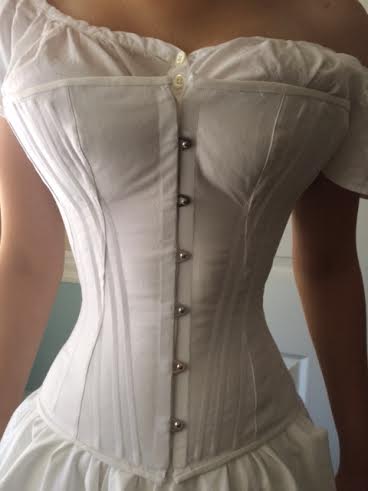
For the first time in basically ever I had no wardrobe breakdowns; at this event exactly one year ago I stepped on my dress while dancing and tore a HUGE hole in it. I didn't step on my dress once, but a couple other people who will remain unnamed did. It was my first time dancing in a corset, and it was actually not as big a deal as I thought it would be. Actually, the dropped armscye was more pesky to dance in because it's hard to raise your arms up. It was also my first time wearing this particular corset to an event, and it was so much more comfortable than the last one! I loved it, but again I didn't feel hungry until I got home. I ate breakfast at around 7:30 and I didn't eat again until I got home at 4:30 and took it off. Instantly my stomach realized it was empty and man I was HANGRY!

One of the most unintended surprises was a man who wanted to take a virtual reality video of us dancing; I don't have the entire clip, but here is the video of the entire event. You can turn the whole thing around and watch all angles of what's going on.
https://www.youtube.com/watch?v=at50y5ABp5M&feature=youtu.be

Monday, October 19, 2015

Something Governess-ey

I'm a costume junkie, although a lot of people who read this blog are probably exactly the same. Anyway, I've recently discovered I love Halloween because it gives me an opportunity to try some type of costume which I normally wouldn't try.

Several weeks after Halloween I've been invited to a costume party, the theme being books. Dress as someone from your favorite book. While I could go as Jane Eyre (who I love), I've decided to go as a different well-loved literary governess with a dress inspired by Jane Eyre. I'm going with something 1840's-ish with a dash of 1850's. Historical accuracy isn't neccesary, although the shape and a few historical techniques have to be thrown in (come on, how else do you get 160'' down to 24'' without the right techniques?). A couple things I will leave off is piping except at the waist edge, and a large hem facing (a turned hem by machine is way faster).

With the theme of only being governess-ey, and also working on a budget, I'll be working with cotton/poly broadcloth in brown, for as my heroine once described her dress as being "somewhere between russett and bark", while her pupils insist that it is "somewhere between stick and mud".

Here are a couple sketches of what I'm going for:

A plain jane, with a slightly dropped waist, bias cut sleeves, and a dull point found in a lot of 1840's dresses. and buttoning up the front. Most 1840's dresses were fastened up the back, but my character shows quite a bit of independence and wouldn't have wanted help getting dressed. This dress is the most similar to what she wears on the front cover. I was experimenting with armscye placement, disregard the lopsided seams.

A little similar, but with a basque. This is the only dress which borrows and element that was very popular during the 1850's, but I thought it was an interesting way of adding another detail that was unusual. It could be either cut in one with the bodice with shaped seams, or sewn separately and maybe even with gathers. And whoops, I left off the head.


And the last is a fan front, which reads as very governess-ey, but the dress fastens up the back and I personally hate not dressing myself. I've always wanted to try a fan front, but I don't think this is the best opportunity to try it.


I have several other costumes to get done before the 2nd week in November, although I'd like this dress to be done by Halloween. As my favorite governess once quoted from the founder of her beloved school, “When the impossible becomes only difficult, that is when you know you’ve won.” Have you figured out who it is yet?

Friday, October 16, 2015

Dress Purpose and Difference, 1860's

After talking a little about the reality of a lady having a dress for every single occasion, there then follows the discussion of what type of dress can be labeled as what. What does a day dress look like? Is it any different from an afternoon dress? If an afternoon dress exists, then does a morning dress exist? If there is a morning and afternoon dress, then when would a day dress be worn? Is there a difference between an evening dress and a ball dress? Fashion plates even include things like promenade dress and a house dress. What the heck is that?!?


Again, the status of the lady and what kind of day it is will dictate whether there is any difference at all. Also, understanding the typical schedule makes a huge difference. Whether a dress is supposed to be worn during what time of day isn't really important, it's more the mentality behind it.

From my experience (which isn't a lot), there is no difference between an afternoon dress and a day dress; anyone who calls it an afternoon dress usually is referring to the fact that there may have been a reason she would have worn something different in the morning. For instance: a lady wakes up and has a good amount of housecleaning to do, including scrubbing the floor and removing all the ashes from the stove, but she's been invited later on to attend a quilting party. If she gets soot all over her dress, she would very well not wear her day dress she plans on wearing later, so she might put on a wash dress (a work dress). It probably wouldn't have been called a morning dress, because it isn't so much a dress that you wear in the morning so much as a work dress. If she was working all day long in one dress, you couldn't call it a morning dress.

An excellent, used work dress from Alabama, 1863

Later on, she might change into something more like this; the style is very conservative, but just by having specific working clothes keeps her day clothes nice.


The typical order of events in a day was get work done in the morning, and then social events in the afternoon. However, a lady who lives on a farm and does work all day long might never have the free time to do any kind of social events regularly, and likewise Mary Todd Lincoln will never ever have occasion to do any work in the morning at all.

If a lady had no work to do whatsoever in the morning and of the upper class, her before noon attire (i. e. probably not going anywhere and no one coming over), she might wear a morning dress, or a house dress. Fashion plates depict both as being excessively frivolous, although I'm guessing the reality was not nearly so. Later, during the time of afternoon she may or may not change depending on whether she plans to leave the house or expect visitors at home, although on a typical day either/or was the usual. Conclusion: a morning dress, the proper type, is not the same as the lady who woke up and had housework to do. The actual difference was like the difference between yoga pants with a sweatshirt and a little black dress with stilettos.

Another term for house dress could be a wrapper, which could have many functions for at home wear ranging from fancy silk to faded cotton to maternity wear. Women from many different social standings wore wrappers, but some were more useful and could have been worn as the most informal kind of dress. They are comparable today to a dressing robe. The main difference between a dress and a wrapper is that a wrapper typically has an adjustable waist and was meant to be worn with less undergarments (reading into that, without a corset). Some were very intricate (like the first one), and others were much less so (the one underneath is shown without a belt or drawstring, in cotton).


Isn't it funny how, when invited to someones house for dinner, or attending a party, and the invitation says 'casual', you then proceed to wear your nicest "casual"? Casual is an extensively broad term nowadays and means basically everything under the sun except black tie apparel. But the unspoken rule is that casual at home could mean your pajamas if you so chose, but going to a casual party doesn't mean your casual at home wear (yikes!). See what I'm saying? One person's casual is anothers sleepwear, and another person's everyday wear (like suit and tie to work) is anothers formal.

Back to the past.

The term promenade dress and afternoon dress are almost synonymous, in that both were the clothing that you wanted to be seen in. Using the above example, the range of acceptable was entirely personal; one ladies day dress might be someone else's evening dress, and vice versa. The words promenade and afternoon were probably replaced with the description day dress. I don't call my grungiest clothes morning clothes and then my rest of the day clothes afternoon clothes, I just spend more time in one or the other more. Also, anyone who calls their afternoon dress a day dress could be in denial that they spent time in anything less nice.
Promenade Dresses, c. 1858
A wool day dress

A printed wool challis day dress
A silk day dress, from the MET
Silk moire day dress, c. 1862-65, from Augusta Auctions

See how much of a variety there is in terms of how nice a day dress can be? The first two were more plain, but the last is far most expensive, but still a day dress.

Another way to tell the difference between a morning dress and an afternoon dress (i. e. will I be at home by myself/receiving visitors, or out walking and visiting?) is the actual structure of the garment itself. Fashion plates say that "house dresses" or "morning dresses" were very fancy. If they never left the house, they could have been made excessively nice and kept that way for years. An "afternoon dress" or "promenade dress", while still needing to be very nice, might have used some techniques to keep it nice and may have needed to be less excessive out of necessity. 

Did you know that there is a difference between an evening dress and a ball dress? Let's look at the expectations between the two, and why they might be different.

If invited to a fancy dinner by the richest lady on the block, you might have several wardrobe options, depending on your income status. If your husband was on the lower end of the spectrum, then your nicest silk day dress will do, but if you are the wife of a politician then you probably have a specific dress just for such an occasion. It's cut more low than a day dress, more similarly to a ball gown, but it is saved specifically for an occasion like this. If an impromptu dance starts, there is no reason why you can't dance in whatever you are currently wearing.
A very nice day dress will do fine...
But an evening dress is even better!

If you are invited to a ball, which might be dinner and dancing, then you may or may not need both an evening dress and a ball dress. If you are attending a ball, you probably are rich enough for both, although whether you want to take the time to wear both in an evening is debatable. The main difference between a "proper" evening dress (the one that is saved specifically for fancy dinners) and a ball gown is the color. Gas lighting produced a really low-lit room, and wearing lighter colors really made you stand out and created a nice graceful look. Many ladies have said that, if wearing a darker colored dress to dance, in low light it makes your dress look detached from your neck and head. The reenactorism is "floating head syndrome", which is fairly accurate. If you are an older woman or if you have no inclination to dance, then wearing a darker colored dress was just fine. The first two are more of a ball gown, the last two are evening. Some dresses fall somewhere in the middle of the color scheme in which you may use your imagination.
Ball gown, ca. 1860 via the MET

Ball gown, ca. 1860-64, via the MET
Evening gown, 1858-59, via the MET
Evening gown, 1865-68, via the MET

We've talked about many different types of dresses and the occasion they could be worn to, but the gist of what different actual dresses (despite what they would have been worn to or called) are as follows:

-Work dress: made of either cotton or wool, depending on whether you wanted it laundered or not. Not every lady owned a grungy work dress, some needed only a less nice dress than a typical 'day dress', and some wouldn't dream of being seen in something like that.

-Wool dress: the range of when wool is appropriate is almost limitless; wool was like the jeans and t-shirt of the era, and could be dressed up or dressed down as much as needed. A plain wool could be a work dress, another one with more trim could be a day dress, and sometimes even sheer wool could be worn as an evening dress, although silk was the most desirable and appropriate.

-Silk dress: of the day dress style, with a high neckline and never with short sleeves, could be worn either as a day dress or an evening dress, or as only the very best of a lower income woman.

-Silk dress: of an evening or ball style, with a low neck and short sleeves. To decide which, take into account the color. For a ball, the lightest weight material is the most desirable, while a heavier silk was more appropriate for an evening dress.

-Sheer dress: of either sheer cotton, sheer wool or sheer silk, I wore my sheer white dress to a reenactment and was asked very bluntly, "what is it for?" Sheer dresses had many different uses, and could range from a work dress in extremely hot weather, to a day dress, also in hot weather, to being an evening or ball gown in an extravagant style. When making my own, I didn't really have an occasion in mind, but mine is definitely of the nicer day style in the summer. It has the potential to be dressed up quite a lot, and I definitely wouldn't do any work in it just because it's so white.

Monday, September 28, 2015

Swirling Thoughts

As you probably know by now, I get really excited about new projects. Right now, I am just bursting with excitement, and also a little anxiety. Anxiety, because I haven't figured out what to do next. The possibilities are just so overwhelming I don't know what to do.

My next personal goal with this new dress is that I want to reproduce something. Be it fashion plate, original, or CDV.

Here is what I have to work with:


Isn't it great? It's a very large scale green and cream silk plaid. Actually, it's more of a very large gingham, but I never think of gingham as anything other than tiny checks. At first I thought it might be a good opportunity to try a different era, but then I decided that the plaid was way too huge to work well with anything other than a hoop skirt. In terms of what to reproduce, well....I have a couple ideas. At the very least, the skirt will be worn with a fitted blouse, but I have enough to also make an actual dress. So....what kind of bodice?


WOW!!!!!

 Even the colors and scale are pretty close! Well, not exactly; the original has a very small pink stripe worked in, but at a distance it's similar. This ball gown is in the MFA in Boston.

Now I'm stuck; we attend a Civil War ball once a year, and I already have a ball dress, so my first thought was that a ball dress was out of the question.  Except, it's made out of dark red polyester with a double skirt. The skirt is about the heaviest thing you've ever felt, and it was not made to go over a corset. I probably could modify it, but the thought of dealing with my early sloppiness makes me shudder. Also, my face gets pink when I dance a lot, especially in a heavy man-made textile dress that is dark red! So probably also not the best color choice.

After experimenting with dancing in my corset, it wasn't terrible; I was worried that during a ball, I would not handle dancing well. But it wasn't too bad; I couldn't be as crazy as I usually am, but that isn't exactly a bad thing. So a ball dress fitted over my corset is not out of the question.

Pinterest has proved to be excellent; so many dresses in almost the EXACT SAME COLOR. Not many have the same huge scale, but enough to give me some ideas. As a rule of thumb in my personal replicating goal, I'm not going to worry about the color being the same, but the plaid scale of the original should be at least a little similar; I've found that a lot of trim just doesn't work with large scale. It's almost too large to incorporate any bias-cut trim, although based on a lot of pictures I really like black contrast.


And then I had a thought: exactly how many day outfits do I need? I only attend between 3-4 events per year, and half of that has to be spent in a wash dress as a laundress.

So now I'm left with two options: MFA replicate, or a day bodice. I'm having a hard time finding a specific picture or original that I love for a day bodice, although I'm guessing that it'll probably be a picture because I've spent much time looking at other original plaid day dresses and none are popping out at me.

Which would you vote: ball gown, or day dress?


Monday, September 21, 2015

Corset 2.0

Yayyy!!! It's done!

It isn't as nice to look at yet as I would prefer, especially laying flat, but it is perfectly functional and will be hopefully long-lasting. Flossing is to come! I am also really excited about the multi-era shape it gives me, being just a little longer than your typical 1860's corsets.

I found that I really liked working with the coutil, but only once I handled it a lot. At first, even coming out of the washing machine and dryer it was really stiff, like canvas. But, by the time it was done, it was much more pliable. I'm also happy that I chose to line with twill instead of coutil, because now I have a lot of coutil left over. The twill did make me pretty angry, because I could have sworn it was stretching just by me handling it...


Moving on from unhappy thoughts. The time it took to rip apart my old corset, turn it into a pattern, and fiddle with the mockup was 15 hours, a lot of which was spent getting the back straight. It's pretty straight, even though it doesn't look so in the picture. Total time to completion was 32.5 hours.

One problem which was a little weird was that the front kept making a weird bubble. Let me show you what I mean; see that funny lump just to the left of the boning channel?


I'm not actually shaped like that. It took quite a lot of ripping out the boning channels and repositioning to fix it, until finally I just went in and shaved off that bit. That fixed it, mostly. I think what happened is I was really paranoid about making sure that it was tight enough right against my rib cage, and I went a little crazy with the cupped flare, making it go more out suddenly than it needed to be. It isn't perfect, but we're getting there.

There are a couple things which I may need to go in and fix; I'm not sure yet about the front length at the top, if it's too high or not. I'll be wearing it this weekend, so I'll get an idea of how practical the entire garment is.

I got a lot of good advice from Elizabeth Clark (HUGE thanks!), and I can't even say how helpful it was!

AAnnnnd.....just because....here is a sneak peek at what I may or may not have just bought 6 yards of....


Historical Sew Monthly #9: Brown

Well, I had some awesome ideas for this month's challenge, but I couldn't make my current large project (a corset) fit in with it. I thought about flossing in brown to make it work, but looking at all those beautiful colorful embroidery flosses at the store, brown just seemed so.....boring. I choose blue instead.

So, I ditched that idea, but instead came up with something easy instead! I wanted something I could work on in the car for the road trip last weekend, but I ended up completing it upon arrival instead of en route. Anyway, it's just the right length, and I really like the fitted waistband. I was worried it would be too big, but over my dress and petticoats it works fine.


What the item is: Pinner Apron

The Challenge: Brown

Fabric: 100% cotton fabric, about 2 yards

Pattern: Sewing Academy pattern, with the bib drafted myself.

Year: Mid-19th Century

Notions: Thread, 2 bone buttons

How historically accurate is it? Having not really done any research in this area, I only know that I didn't use any particularly modern techniques. Since no research has been done, let's say 70%, although it's basic enough that it could be 100% and I wouldn't know. I don't think the print is perfectly accurate.

Hours to complete: About 8, since I handsewed the entire thing.

First worn: Not yet

Total cost: $0, all from stash.

Wednesday, September 9, 2015

How to Calculate Fabric Width Differences

Jen, over at Historical Sewing, has a great article on how much yardage you would need for various garments in certain eras. I've always used the basic "5 yard skirt" method in my historical skirt calculations, but I've recently had an epiphany about amounts, and also discovering the wonderfulness of fabric that is 60''. I always never know how much to buy, and way overshoot and overspend. My very first dress I bought 11 yards!
A plaid in 60'' width fabric; I only needed 6 yards for an entire 1860's dress!

I love shopping fabric online. It's awesome. But comparing prices is sometimes tricky, because I forget to calculate the difference between 60'' fabric and 45'' fabric. If there are two different wools, and one is $8 a yard and the other is $10 a yard, I might choose the cheaper one being the cheapskate that I am. BUT...upon further research, you find out that the $10 a yard is actually 60'' wide and may even SAVE you money....if you know how to make the proper calculations as to how much you need. You won't be doing any saving at all if you buy the same amount as you would for 45'' fabric, even if you have gobs leftover.
1 yard pieces of 40'' silk taffeta

It is true that 5 yards is close to the amount you would need, but only for a 45'' fabric if you want 4 panels. Before even beginning to start fabric shopping on a budget, grab your measuring tape and pad of paper, and we'll calculate how much yardage you will need.

Start by figuring out how long your skirt needs to be. Take the longest measurement, and add enough for hem and turnover at the top, if you use that method. My finished skirt length at the longest measurement (in the back) is 43'', so I'll add 2'' for turnover at the top, and 1/2'' to attach the hem guard. Rounding up, my total cut panel length is 46''. That isn't going to change from width to width, so hang on to it!

Beginning with 45'' fabric, I'll need 4 panels. Here is the formula:

Cut Panel Length x Amount of Panels, Divided by 36'' = Skirt Yardage

This applies to 45'' and 60'' widths. So for me, I will need 5.111 yards for 45''. I'd probably round up to 5 1/4 yards. For 60'' fabric, I would only need 3.83 yards, round up to 4. That's considerably less! If I paid $8 a yard for the 45'' widths, I would be paying $42. For 60'' widths, I would be paying $40. I know, $2 isn't a huge difference, but it definitely makes some of the 60'' prices look much more affordable than you might think.

After that, calculating bodice design is pretty dicey. I've found that, a basic bodice with plain coat sleeves, you can probably get away with 2 yards even in 45'' fabric. You may even need to do a little bit of piecing, but I've had no trouble with 7 1/2 yards of that same style. For larger sleeves, you will definitely need more; 3 yards total should cover most styles. Huge pagoda or bishop style sleeves you may want to up it to 3 1/2.

For 60'' width fabric, I haven't really experimented with what the difference in yardage is, BUT...using a different way of comparing, we can figure out how much we will need. 45'' to 60'' is 3/4, or 75%. See what I did there? You will need 1/4 less fabric than in 45'' fabric. That makes a basic bodice (the 2.5 yard kind) being a little under 2 yards, with the most being 2 3/4 yards.

There you have it! I'm getting better at calculating in my head, and having the finished skirt measurement written down in my notebook makes a huge difference.